Governor-General (the Prince)
Dead SoulsGovernor-General (the Prince) is the highest authority in the closing legal crisis of the narrative: he orders Chichikov brought before him, accuses him of returning to fraud after an earlier act of clemency, and commands that he be removed as a prisoner. His confrontation with Chichikov centers on a woman induced to witness a will, while his later refusal to set aside the law establishes the boundary that even Murazov’s appeal cannot readily cross.
Identity and Introduction
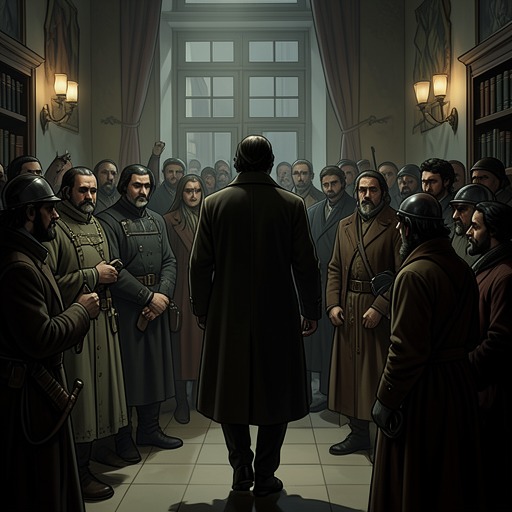
The Prince appears not as a distant name but as an arresting presence. A gendarme announces that Chichikov is commanded to present himself before the Governor-General, and the order is reinforced by the armed figure at the doorway: moustache, plumed helmet, crossed shoulder-belts, and a gigantic sword. A second apparition stands outside, while a coach waits beneath the window. The display of force leaves no room for negotiation; Chichikov, still dressed in his carefully chosen finery, is taken away with a gendarme beside him.
At the Prince’s residence, the summons continues without pause. An aide-de-camp tells Chichikov that the Prince is awaiting him and directs him into a study crowded with portfolios, ledgers, and dispatch-boxes. The room’s working documents and the Prince’s grave, menacing figure present authority as both administrative and personal: Chichikov enters a world of records and official decisions, facing the man empowered to act upon them.
Charge and Confrontation
The Prince’s anger is already visible when Chichikov is brought in. He reminds him that he had once spared him and allowed him to remain in town when he should have been imprisoned. In his view, Chichikov repaid that clemency by resuming fraud, and not merely an ordinary deception but conduct he calls profoundly dishonourable. The accusation makes the present crisis a recurrence: the Prince sees a former chance to avoid prison answered by another offense.
When Chichikov asks what fraud he means, the Prince identifies a specific matter: a woman whom Chichikov induced to witness a certain will has been arrested, and Chichikov will be confronted with her. The accusation suddenly dims Chichikov’s world. He begins by promising the whole truth and admitting guilt, but qualifies that admission by saying he is not as guilty as the Prince believes and was led astray by rascals. His response attempts to shift the account from deliberate wrongdoing toward circumstance and the influence of others; the Prince’s charge, by contrast, places responsibility on Chichikov’s repeated choices.
Clemency Refused
Chichikov then pleads in increasingly personal terms. He admits that he lied about having a wife and children, but insists that he had genuinely desired a family and the respect of his fellow citizens and the authorities. He describes a life driven by necessity, temptation, and enemies, comparing it to a barque tossed by tempestuous waves. The appeal is at once confession and self-defense: wrongdoing is acknowledged, but presented as the product of pressures he claims he could not master.
The Prince does not grant the mercy Chichikov seeks. He orders the newly arrived gendarme to summon an escort and remove the prisoner. Chichikov clasps the Prince’s knees and refuses to leave until mercy is granted; as the Prince struggles to free himself and repeats the order, Chichikov clings so tenaciously that he begins to be dragged across the floor in his frockcoat. The contrast between Chichikov’s polished clothes and his desperate, physical grasp makes the appeal bodily and undignified, while the command remains unchanged.
Law and Murazov’s Appeal
Later, Murazov explains that obtaining Chichikov’s release would require setting aside a law. He adds that the Prince is a strict administrator and would refuse to release him under any consideration. The statement clarifies the official’s governing position: the earlier clemency Chichikov recalls has not made the Prince a patron who can be persuaded at will, and the prospect of another release is constrained by both legal procedure and the Prince’s character as an administrator.
Chichikov counters that the law itself is not what troubles him; he claims he could find a way to deal with it. His complaint instead is that he has been imprisoned without offense and deprived of his papers, dispatch-box, and all his property. He again clings to Murazov’s knees and weeps, seeking deliverance through personal intervention. The episode distinguishes Chichikov’s instinct for finding a way around rules from Murazov’s account of the legal obstacle and the Prince’s refusal to disregard it.
Narrative Role
The Prince’s brief appearances establish the decisive opposition between Chichikov’s improvisational pleading and an authority that insists on accountability. His first reminder of clemency connects the present accusation to an earlier opportunity; the charge concerning the witness to the will gives the renewed fraud a concrete focus; and the order for removal turns judgment into immediate action. Later, Murazov’s description of the Prince as a strict administrator keeps the possibility of release from becoming an easy consequence of Chichikov’s tears.
The Prince is therefore defined less by private history than by the function he performs in the closing confrontation: he identifies the alleged offense, rejects Chichikov’s attempt to frame it as misfortune, and enforces the prisoner’s removal. Against Chichikov’s claims of good intentions and circumstances beyond his control, the Prince represents the consequences of conduct already repeated after clemency. The scene’s comedy of extravagant dress and desperate clinging does not erase its stakes; it sharpens the distance between a plea for personal mercy and the official decision to hold him accountable.